

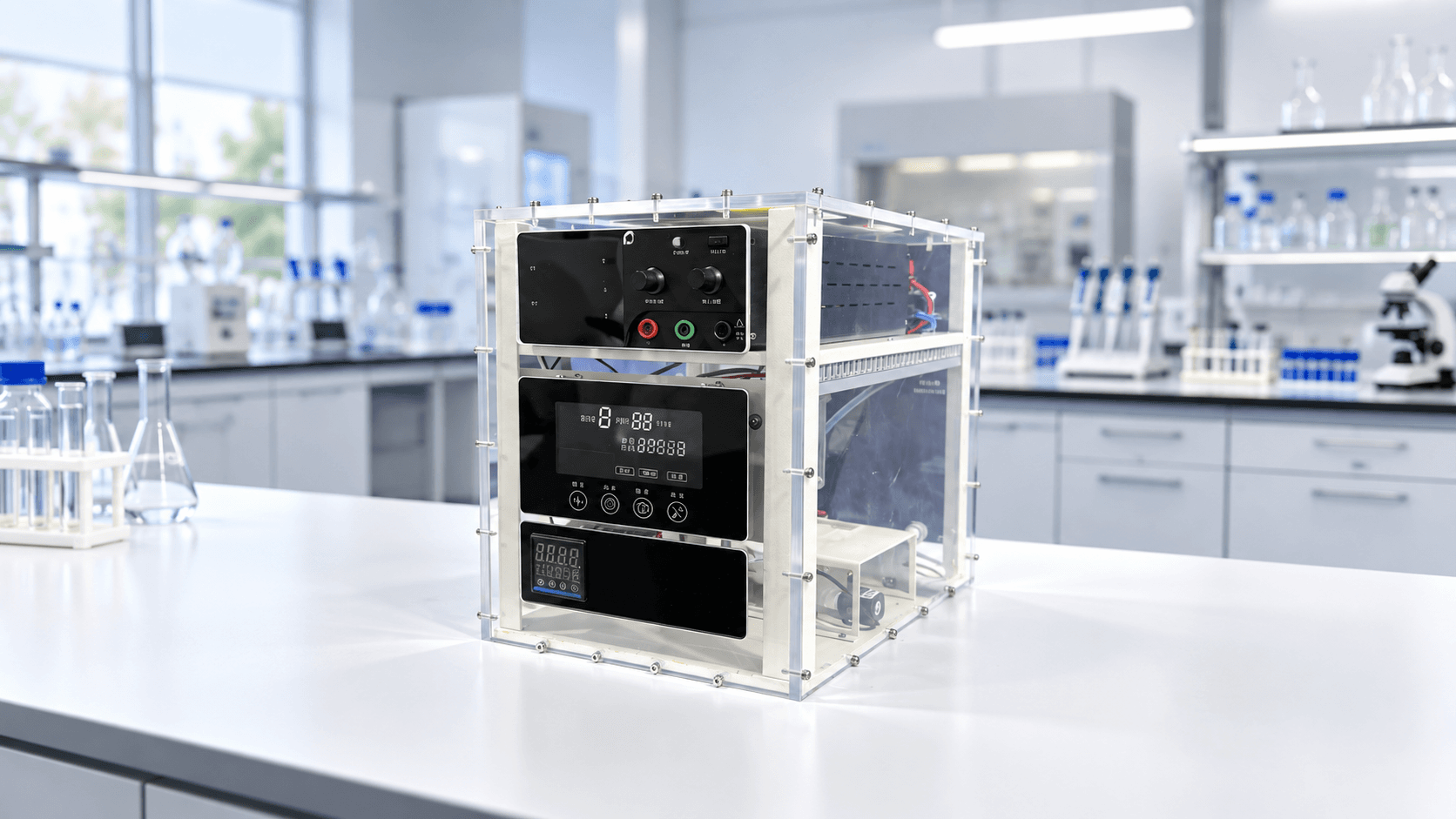
Procurement checks for a PEM electrolyzer test platform — confirm the final configuration against the ordered data sheet.
| Requirement | Why it changes the test result |
|---|---|
| Power range and control mode | Determines whether the platform can run the intended current density, polarization scan or steady-state condition without an improvised power arrangement. |
| Water flow, quality and temperature | Affects cell hydration, heat balance and repeatability; define medium, flow range, conductivity and temperature control. |
| Gas and pressure boundary | Sets the conditions for hydrogen handling, back pressure and crossover-related safety review. |
| Measurement and data capture | Makes voltage, current, flow, temperature and pressure readings comparable across operators and test dates. |
| Protection and shutdown logic | Supports a controlled response to over-current, over-voltage, leakage, pressure or interlock events. |
| Experiment scope | Separates a teaching demonstration from performance characterization, stability work or a development programme. |
When does a PEM electrolyzer test rig change the quality of the data?
A dedicated PEM electrolyzer test rig changes the quality of the data when the laboratory needs to answer a question twice and get a comparable answer. That sounds almost too obvious. Yet many early experiments begin with a power supply, tubing, a flow meter and a stack on a bench. The setup may make gas. It may even produce a promising curve. But if water temperature, flow, pressure, current control and logging change from one run to the next, the result becomes hard to trust.
A basic setup is not wrong. It is often useful for a first teaching exercise, a quick concept check or a component demonstration. The problem begins when the same arrangement is asked to support development decisions, student research projects or a report that must explain why one membrane, catalyst layer or operating condition performed differently. Then the question is no longer ‘did it run?’ It is ‘can another operator reproduce the condition and understand the result?’
A test rig brings the hidden conditions into view. It defines how power is supplied, how water is managed, what pressure is present, where measurements are taken and what happens when a limit is reached. The platform does not guarantee good science on its own. It gives the team a controlled starting point, which is far more useful than a pile of unlabeled assumptions.
For procurement teams, the conclusion is simple: buy a dedicated platform when the cost of uncertain data is higher than the cost of defining the test boundary. That is often true for university labs, research institutes, electrolyzer manufacturers and testing organizations. It is especially true when several people will use the equipment over time. A rig gives every new user the same road map.
What can a basic laboratory setup do well — and where does it stop?
A basic bench can teach the core idea of PEM water electrolysis very effectively. Students can observe the relationship between electrical input and gas generation, identify the roles of water, electrodes and a membrane, and learn why voltage and current matter. For a short supervised lesson, this directness is part of the appeal. There is less hardware between the learner and the phenomenon.
It can also support early exploration. A researcher may use a simple arrangement to check connections, establish a rough operating window or compare an obvious design change. In that stage, speed matters. Nobody needs a full facility just to learn that a valve is connected the wrong way around. A modest setup keeps the first experiment practical.
The limit appears when variables interact. Water temperature can influence electrochemical behaviour; flow and conductivity can affect the operating environment; pressure changes the gas-side boundary; and power control changes what the cell actually experiences. If these conditions are adjusted manually or recorded in scattered notes, a later reader has to reconstruct the experiment like a detective. That is not a great use of laboratory time.
A basic setup also has a service limit. The more it grows through extra sensors, improvised wiring and one-off procedures, the harder it becomes to hand over safely. A test rig is not a luxury cabinet. At its best, it is a way to replace fragile personal knowledge with an agreed procedure, labelled connections and data that remain understandable after the original builder has moved on.
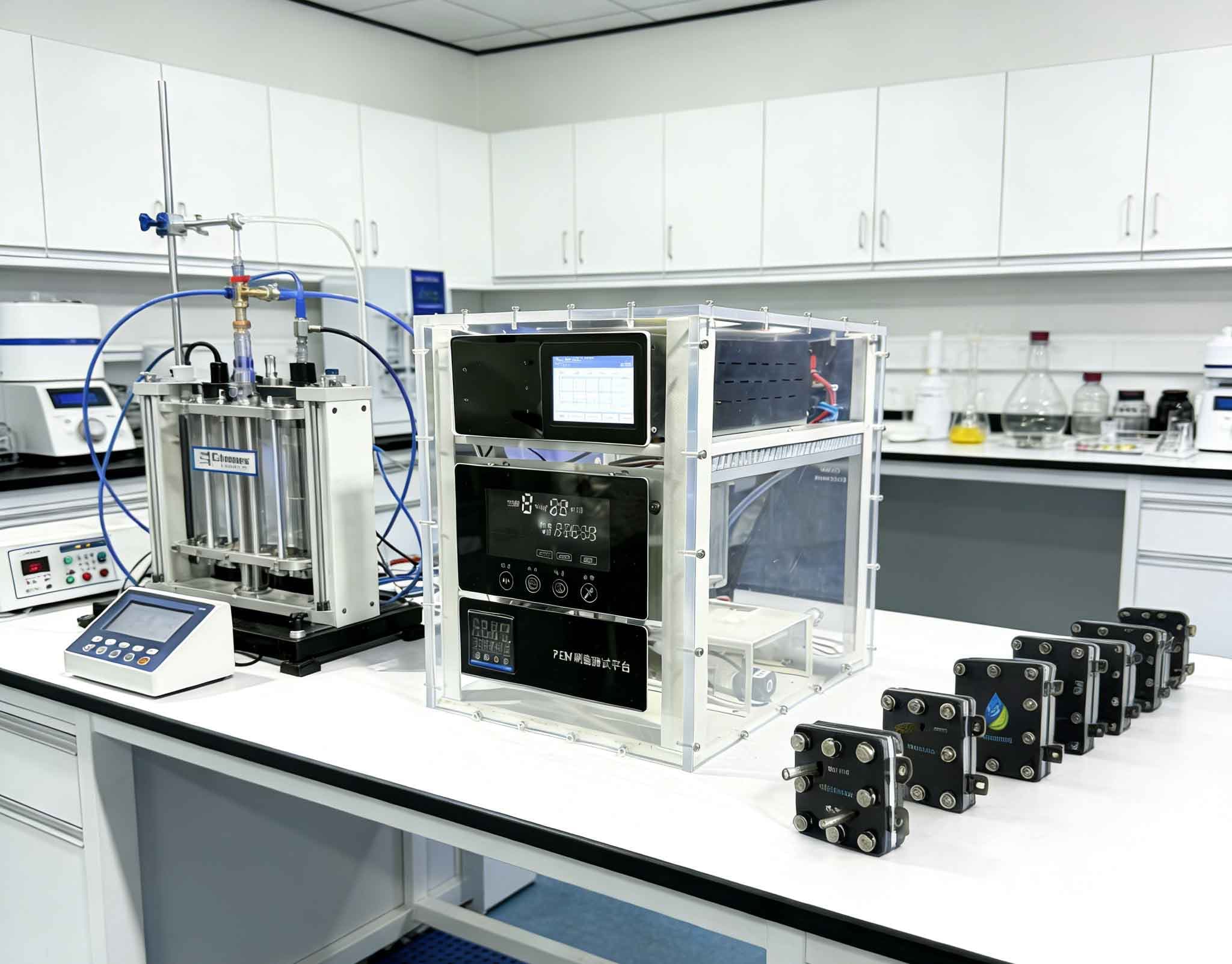
Which measurements should a PEM electrolyzer test platform capture?
Every platform should capture the variables required by the research question, not a random list of impressive readings. At a minimum, teams commonly need electrical voltage and current, water temperature, water flow, conductivity where relevant, pressure and the gas-side conditions required by the test. The important detail is context: each value needs a unit, sensor location, timestamp and operating state. A current value without a temperature or pressure context tells only half the story.
For performance work, a polarization curve is often a useful starting point because it shows the relationship between voltage and current under a stated condition. The curve is not magic. Its value depends on stable inputs and a recorded test method. If the water condition or cell temperature drifted while the points were collected, a beautiful graph can still mislead. The record should make the condition visible enough for the next person to repeat it.
For stability work, the time history matters. A short reading can look healthy while a longer run reveals drift, pressure changes, temperature movement or an intermittent control issue. Buyers should ask whether the platform supports the intended constant-current or constant-voltage operation, how data are saved and what happens during a power interruption. Those are small questions with large consequences for a long experiment.
Vemdra's VDTA01 product record lists a 0–15 V power range, 0–30 A current range, a water-flow reference of 300 mL/min, room-temperature to 60 °C adjustment and USB communication. The VDTA02 record lists a 0–15 V power range, 0–60 A current range, adjustable water flow from 0.15 to 600 mL/min, room-temperature to 80 °C control, USB and RJ45 Ethernet communication, and a stated 0–0.4 MPa back-pressure range with 3 MPa optional. These are reference facts for a project brief; the ordered configuration and final data sheet remain the decision documents.
How do water, gas, power and heat need to work together?
A PEM electrolyzer experiment is a connected system. Power pushes the electrochemical reaction, but water supplies the process and moves heat; gas handling defines part of the outlet condition; and thermal control affects the operating environment. Looking at only one module is like judging a kitchen by its oven while ignoring the ingredients, temperature and timing. The parts are related, so the test method must show their relationship.
Start with water management. The buyer should define the required water quality, flow range, refill method, conductivity monitoring and temperature range. Vemdra lists deionized water and conductivity below 1.5 µS/cm for the VDTA01 and VDTA02 water-management descriptions. That does not mean every project can use the same operating point. It means the water condition belongs in the specification and test record, rather than being assumed by the person filling the reservoir.
Then define the gas and pressure boundary. Is the work an atmospheric single-cell experiment, a controlled back-pressure study, or part of a larger gas-handling arrangement? What connections, vents, sampling points and safeguards are needed? The VDTA02 product record includes hydrogen-leakage detection, high-pressure alarm, emergency stop and interlock alarm shutdown in its safety description. A buyer should request the exact scope of these functions for the selected configuration and review the installed laboratory arrangement with qualified local personnel.
Finally, decide how the platform reaches a safe state. A clear shutdown sequence, labelled utilities and logged alarms make teaching and research calmer. Nobody wants an experiment stopped by a mystery fault five minutes before a class begins. Simple operating discipline is not flashy, but it is one of the reasons a purpose-built platform becomes useful week after week.
Need a configuration direction for your application?
Share your required flow, purity, pressure, operating profile and destination. Our team will help identify the questions your specification should answer.
How can a buyer compare suppliers without buying a black box?
Begin with evidence that the platform fits the intended experiment. Ask for the product data sheet, supported test functions, power and water ranges, pressure boundary, sensor list, data interface, drawings, operating manual and a clear list of customer-supplied utilities. A supplier that can explain these items plainly is easier to work with when the project moves from quotation to installation.
Next, ask what is actually measured and how it is recorded. A display is not automatically a data system. Clarify which channels are visible, which are exported, the sampling approach, file format, communication interface and any software or computer responsibility. If the team needs IV curve scanning, long-duration operation or an I–t record, state that requirement before quoting. Do not assume a general testing label covers every function.
Certification requests need the same precision. Identify the applicable destination, model, electrical configuration and document needed by the institution. A certificate or declaration related to one component does not automatically apply to the whole installed platform. The current product records used for this article describe functions and parameters but do not name model-specific certificate files, so this article does not claim them. Request the relevant evidence before approval, not after the crate arrives.
A practical supplier review also includes factory test evidence, packing information, serial-number traceability, maintenance guidance, recommended spares and training support. These are not administrative extras. They show whether a rig can become a repeatable laboratory asset rather than a one-semester project. The most persuasive quote is the one that makes the handover feel routine.
What procurement risks can a purpose-built test bench reduce?
The first risk is false comparison. Two cells or stacks can appear different because the materials changed, but they can also appear different because the water temperature, flow, pressure or measurement method changed. A controlled test bench cannot eliminate every source of uncertainty. It can reduce the ones that come from an unstable laboratory setup and make the remaining limits clear.
The second risk is an incomplete system boundary. A buyer may order a test platform and later discover that the site still needs a specific water arrangement, electrical feed, exhaust route, computer, data cable, pressure connection or safety review. Put every interface into the RFQ. If an item is not finalized, mark it as open and assign who will close it. A clear unknown is safer than an invisible gap.
The third risk is buying a platform that is too simple or too ambitious. A teaching lab may not need a research-grade pressure range. A development team may outgrow a demonstration unit quickly. The remedy is to write the use case first: single-cell teaching, performance characterization, stability testing, operating-condition simulation, service-life study or industry-university project. One sentence can prevent a very expensive mismatch.
The final risk is losing operational knowledge. Ask for startup, shutdown, cleaning, calibration, fault response, routine inspection and data-handling guidance. If a technician must explain the whole system from memory, the programme is fragile. Good documents and training make the result more reliable for the next student, the next researcher and the next project review.
What should be included in a PEM electrolyzer test-rig RFQ?
A strong RFQ begins with the test object: cell type, active area if known, intended current or voltage range, operating duration and target measurements. Then list the expected water condition, pressure range, temperature range, desired control modes, gas-management boundary and data-export need. This tells the supplier what the platform must do rather than asking them to guess from a product category.
Add the laboratory context: institution type, research or teaching objective, users, available utilities, space, destination country, timing and who will install or supervise the system. For a course, include the number of student groups and experiment duration. For R&D, include the planned test matrix and whether the work needs constant-current operation, scanning, logging or a longer stability run.
Finish with the acceptance and document package. State the requested factory test scope, manuals, drawings, training, packing record, service expectation and any destination-specific evidence required by procurement. Vemdra can use that brief to discuss VDTA01, VDTA02 or a suitable test-platform direction around the real test boundary. That is more useful than choosing on appearance alone.
Prepared by Sunny Shen, Hydrogen Solutions Consultant at Vemdra. This guide is an engineering planning resource, not a substitute for a site-specific hazard review, applicable codes, or the instructions supplied with the final equipment.
Frequently asked questions
What is the difference between a PEM electrolyzer test rig and a basic lab setup?
A test rig integrates controlled power, water, gas, temperature, measurement, logging and protection functions around a defined test boundary. A basic setup can be useful for demonstrations or early checks, but it may not control or record enough conditions for repeatable development data.
What parameters should a PEM electrolyzer test bench measure?
Measure the parameters needed for the intended method, commonly voltage, current, water flow and temperature, conductivity where relevant, pressure and the agreed gas-side conditions. Record sensor location, units, timestamps and operating state.
Can Vemdra test equipment support IV curves and stability testing?
The current VDTA01 product record states IV curve scanning and long-duration constant-current or constant-voltage operation with I–t recording. Confirm the final ordered model, test method and data requirements with Vemdra before purchase.
What safety evidence should a university request for an electrolyzer test platform?
Request the applicable data sheet, safety functions, operating manual, wiring or process documents where relevant, factory-test record if agreed, maintenance guidance and destination-specific documentation. The installed laboratory still needs qualified site-specific review.
How do I request a quotation for a PEM electrolyzer test bench?
Provide the cell or stack type, operating range, water and pressure requirements, test functions, logging needs, laboratory utilities, intended users, destination, documentation list and target delivery date.
How this guide was prepared
Vemdra's editorial team uses application discussions, project-planning experience and publicly available technical references to frame these guides. Technology claims and site requirements should always be checked against current equipment documentation and local standards before a purchase or installation decision.
For background reading, consult the U.S. Department of Energy overview of hydrogen production by electrolysis and applicable local regulations.